Cybersecurity

The ZK-Proof Supply Chain: Verifying Provenance in 2026

Explore the ZK-proof supply chain in 2026. Learn how zero-knowledge proofs are providing mathematical certainty about the origin and integrity of code, data, and digital content, creating a foundation for trust in an AI-saturated world.

Sachin Sharma
Sachin SharmaCreator
Apr 9, 2026
2 min read
The ZK-Proof Supply Chain: Verifying Provenance in 2026
Featured Resource
Quick Overview

Explore the ZK-proof supply chain in 2026. Learn how zero-knowledge proofs are providing mathematical certainty about the origin and integrity of code, data, and digital content, creating a foundation for trust in an AI-saturated world.
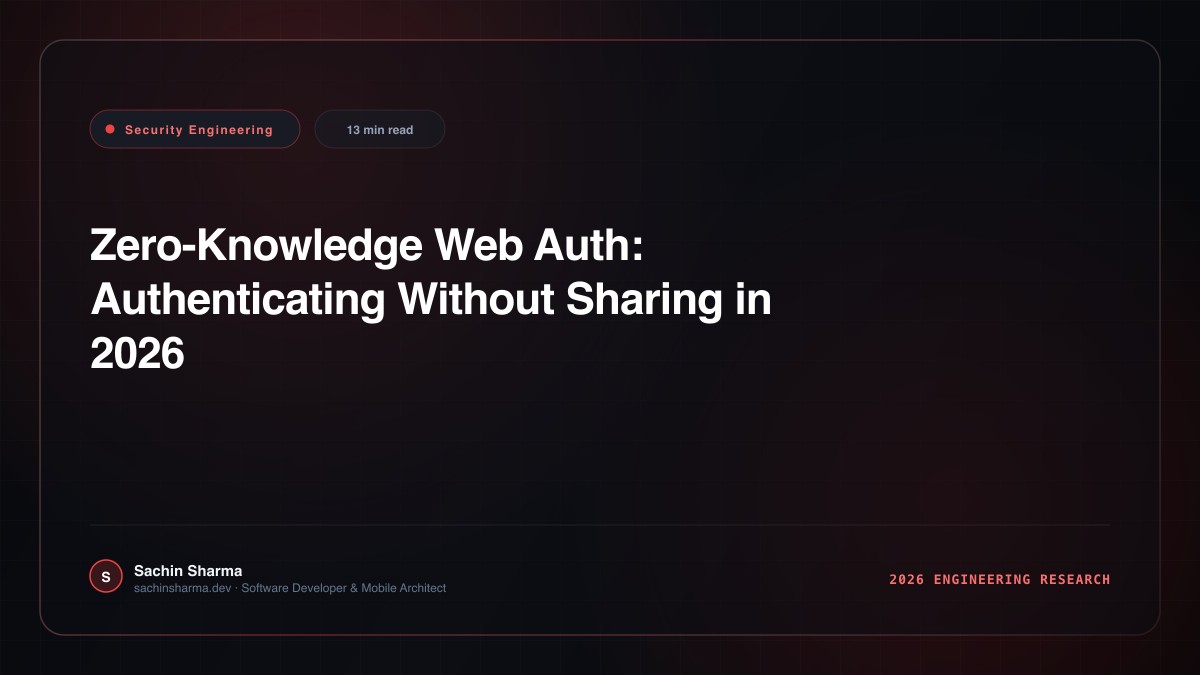
The ZK-Proof Supply Chain: Verifying Provenance in 2026

In the mid-2020s, the internet faced a "Trust Crisis." Deepfakes, AI-generated code vulnerabilities, and malicious supply chain injections made it impossible to know if a piece of software or content was authentic. In 2026, we solved this with the ZK-Proof Supply Chain.

Trusting the Origin, Not the Middleman

Using Zero-Knowledge Proofs (ZKPs), we can now provide mathematical certainty about the Provenance (origin) of digital goods without revealing sensitive proprietary data.

  1. 2.
    Code Provenance: When you pull a library from the Mesh Web, it comes with a ZK-Proof that it was compiled from a specific commit of a verified repository and scanned by an Autonomous Security Agent for 0-days.
  2. 4.
    Content Authenticity: News articles and videos carry ZK-signatures from their source (e.g., a specific journalist's hardware key) that prove the content hasn't been altered by unauthorized AI post-synthesis.
  3. 6.
    Data Integrity: In our Universal Semantic Layer, data points carry ZK-proofs of their calculation logic, ensuring that a "Revenue" figure wasn't manipulated by a rogue agent.

Why it Matters in 2026

  • Bypassing the "Audit Tax": In 2026, compliance is "Always-On." Because everything is ZK-proven, auditors don't need access to your raw data; they just verify the proofs.
  • Neutralizing AI Poisoning: We can now mathematically separate human-authored code from AI-synthesized "Shadow Code," allowing for strict governance in critical infrastructure.
  • Privacy-Preserving Trust: You can prove a dataset was collected in compliance with GDPR (via Programmable Privacy) without exposing the underlying PII to the verifier.

The Developer Workflow: "Proof-Centric CI/CD"

As a developer in 2026, your CI/CD pipeline doesn't just run tests; it generates Proofs. If a build doesn't have a valid ZK-Chain of Provenance, it simply cannot be deployed to the Autonomous Infrastructure.

Conclusion

The ZK-proof supply chain has rebuilt the foundation of trust for the digital world. In 2026, we don't ask "Who sent this?"—we ask "What is the proof?" By building with provenance in mind, you are ensuring your software remains credible in an age of infinite synthetic content.

Sachin Sharma

Sachin Sharma

Software Developer

Building digital experiences at the intersection of design and code. Sharing weekly insights on engineering, productivity, and the future of tech.